


Lem at Amazon

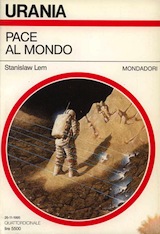
The last voluminous book about the adventures of Ijon Tichy tells a story that takes place in a near future. Earthly superpowers send their arsenals and arms factories to the Moon, so that they can evolve there by themselves, leaving the Earth in a state of peace and welfare. The fear of what had been born from these arsenals forces international organizations to send Ijon Tichy in a secret mission to the Moon. Once there, the protagonist suffers from a strange accident: his brain becomes callotomized, i.e. the two hemispheres of his brain are separated. Tichy – in his psychical duality – becomes a puzzle to himself and his environment; he is also a deponent of a mystery he remains unaware of, desired by all intelligence services of the world.
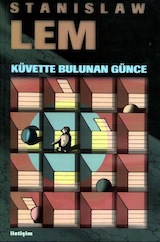
"Memoirs Found in a Bathtub" is one of the most intriguing books by Lem. The ostensibly funny satire of contemporary intelligence, scarred by betrayal of trust, in reality is – as is the case with everything in spies' world – an encrypted text. Attentive reader will discover critique of a totalitarian state, but also a parable of a man lost in the cosmos of signs generated by society, culture, literature, the physical world and biology. Hence grotesque softly turns to philosophy.

"Inspection at the Scene of the Crime" is one of the most original of Lem's novels. At first glance a political satire, best understood by the witnesses of the cold war, "Inspection..." is a serious intellectual attempt at creating a model of a future civilization. How to secure an equilibrium, safety and – for individuals – a meaning of existence? What technology should replace Nature or God? How to address the emptiness and suffering that even this protective, but "cold" and impersonal technology cannot remove from the life of planet's inhabitants? Ijon Tichy, getting to know the remote Encja, seeks answer to these questions – and many others.

By pure chance scientists discover a signal from space that could be an statement from rational beings. How can we read this message knowing nothing about the senders? What if we are not even sure whether they exist? "His Master's Voice" is not a typical book. It lacks an adventure plot, yet struggle with the mystery rivets readers' attention more than in many adventure books, especially since the encounter with the unknown provokes elementary questions about the nature of the world, nature of man and reasons for defects of Being.

Lem wrote "Highcastle" at a time of greatest literary triumphs as an author of science fiction, but the book does not belong to this genre. This is a self-portrait of a writer from the times of his childhood, inquisitive, full of humor, a story about the birth and development of a personality, intelligence and imagination. With the pre-war Lvow as background Lem tell the story about adolescence - as attractive and full of surprises as his fictitious tales. Why does one go back to one's childhood? Initially, for sentimental reasons and for the reconstruction of the past world. Later, in order to understand oneself better at a mature age and, at the center of this panorama, to raise a High Castle - of meaning, a memorial of covenant between the past and the present.
.jpg "Golem XIV")
"Golem XIV" is one of Lem's most far-fetched intellectual adventures: for the purpose of this book Lem constructs the character of a supercomputer of the future that infinitely overshadows human intelligence. Golem, whose history we follow from its birth until his inexplicable departure from the human world, not only mercilessly criticizes humanity, claims of our culture and delusions about allegedly refining mechanisms of evolution, but also creates a breathtaking vision of further development of artificial intelligence – beyond our cosmos and cognition available within its limits.

"Eden", written in 1959, opens the period of Lem's mature science-fiction. What makes us read this book with interest today? Certainly author's exceptional imagination plays an important role here; rich visions of planetary culture and nature are presented with just the right amount of suspense. Hence, we get to know the mysterious planet step by step – with a tension that naturally accompanies all real history of exploration. Political system of the planet must have reminded readers of Orwell's visions, particularly in the 1950s. Yet the most important issue seems the skepticism with respect to the possibility of mutual comprehension: the very difference of respective technologies prevents newcomers and locals from understanding each other.

"The Astronauts", one the most famous novels by Lem, was initially published in 1951; since it had to comply with the schematics of the so-called socialist realism in communist Poland, Lem was reluctant to authorize reissues. His first novel dedicated to interstellar travel presented author's exceptional imagination and faith that reason eventually would overcome political madness. The story of Earth attacked by Venus, previously destroyed in a fratricidal battle, remains a moving vision of results of primitive practicism and struggle for power.
Page 2 of 2