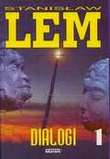
“Dialogs” come from times when cybernetics seemed to offer infinite possibilities. This optimism, although moderated by the author, manifests itself in first chapters. Later, Lem argues with himself presenting his thoughts in a constant movement. The most interesting are analyses of society and its institutions - Lem is predominantly interested in human thought that could make the world livable. "Dialogs" were not entirely translated to English.
4.50 out of 5 based on 2 ratings2 user reviews.
German 1980 Suhrkamp Edition
Reviewed by Nicholas Dreyer on
.
I have read the 1980 German Suhrkamp Edition twice, and find it so great, think it would be very important to get this work more widely recognized. It is clear from Lem's extraordinarily profound and ever more relevant speculations, that he, as he himself remarks in the after-word to this edition, was "born a philosopher". One important way to reach a wider audience would of course be to get the work translated into English. Have sent a note to rights@lem.pl expressing interest in collaborating on such a project. I hope others will join in!
Probably the most provocative, and daring of suggestions Lem makes for obtaining significant advancement of human kind involves controlled social experiments. Given how seriously destructive and out of control technological development has become under the currently dominant societal arrangements, this message seems ever more prescient and urgent.
Oddly I do not recall his claim in https://english.lem.pl/works/essays/dialogs/105-lems-opinion that the book contains a prediction of "the collapse of the communist command economy", but this could be a detail that has slipped my far-from-perfect memory. It might also be due to how startled I was by his effective advocating for the type of social experimentation I mention above, which he quite clearly states is much more likely to yield useful outcomes under social orders more closely aligned with socialist than capitalist models. Of course it is important not to confuse the Stalinist distortions which have so falsely claimed the name of socialism with the genuine article (which has thereby been dealt a possibly fatal disservice). I presume by "command economy" he really means "Stalinist" in the opinion piece. In any case his criticisms in the book of the shallowness and destructive chaos of the US-inspired styles of societal orders are quite evident and spot on.
This should be required reading in any university social studies or artificial intelligence curriculum!
Rating: 55
Lem as a staunch (and scary) neo-socialist
Reviewed by Hiroo Yamagata on
.
This is a very important book that shows Lem as Scary fascist=socialist. The earlier chapter outlines whether human consciousness can be artificially created (Lem says yes), whether "self" is reproducible (Lem kinda sorta says yes/no) and other SF-ish themes, citing the new discipline of Cybernetics to decipher the feedback loop inherent in these systems.
But the real fun is in Chapters 7 & 8. Lem applies this idea to social and economic systems. He DOES criticize the then-existing socialist central planning, because it doesn't take into account the feedback inherent in economic systems. However, Lem repeats the standard Marxist view that Capitalism is doomed because it will break under increasingly severe economic boom and bust cycles. Socialism will take over the means of production, automate everything, which will allow infinite production where the price signal/feedback will no longer work. A new feedback system utilizing Cybernetics would be installed, Lem says.
This will require trial and error, and there will be resistance. Lem says we should squash these old guards with force (!!). During the adaptation to the new system, human rights should be supressed (!!). Under the new system, there will be some aptitude test to separate smart leaders and stupid workers, but this is not any class separation, it's just a sorting system to allocate people according to their abilities.
Lem never retracted these views. He kept these as is in later re-issue of the book. I think he believed in them till the end. It is tempting to view Lem as a liberal thinker, but he actually isn't. This book shows his true colors, which makes it important.
Rating: 45



 “Dialogs” come from times when cybernetics seemed to offer infinite possibilities. This optimism, although moderated by the author, manifests itself in first chapters. Later, Lem argues with himself presenting his thoughts in a constant movement. The most interesting are analyses of society and its institutions - Lem is predominantly interested in human thought that could make the world livable. "Dialogs" were not entirely translated to English.